
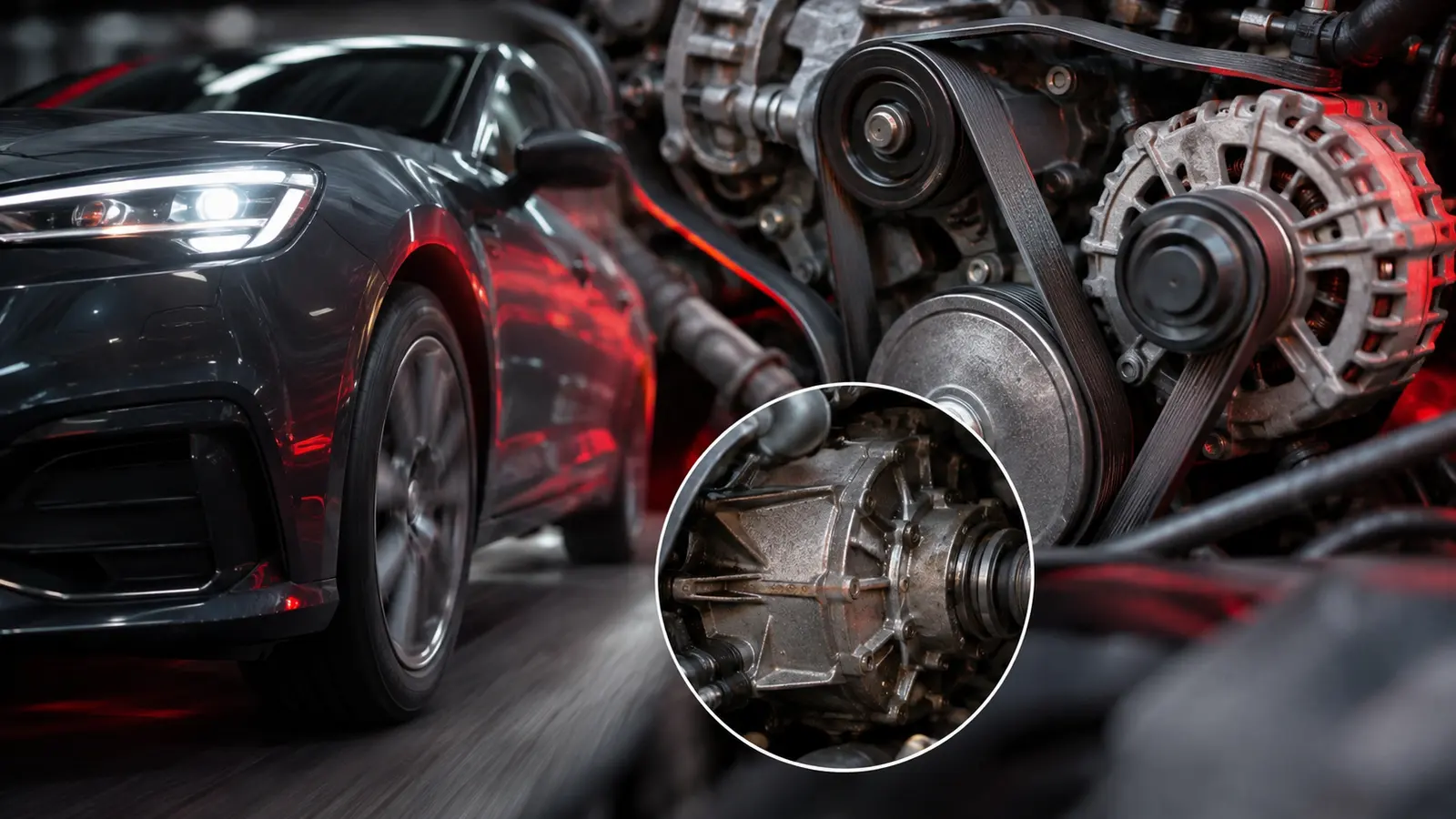
Whining Noise When Accelerating: Causes
Quick answer
First work out whether the whine follows engine speed or road speed. Engine-speed whines are usually belts, pulleys, the alternator or power steering. Road-speed whines point to wheel bearings, the differential or the gearbox.
- Topic
- Transmission & Clutch
- Sections
- 6
- Reading time
- 1 min
- Applies to
- All regions
A whining noise when accelerating has two main families of causes. If the whine follows engine speed, look at the drive belt, pulleys, alternator, power steering pump or a turbo. If it follows road speed, look at wheel bearings, the differential, the gearbox or a CV joint.
Is it safe to drive?
Usually, carefully. A loud grinding whine, burning smell, warning light or loss of drive means stop and get help.
Find which family it is
- Parked, in neutral: rev the engine gently. Whine present = engine-driven.
- On the move: note whether it changes when you coast versus accelerate.
- Turning: a bearing whine often changes as you steer left and right.
Causes at a glance
| Clue | Likely cause |
|---|---|
| Whine with revs, louder when steering | Power steering pump or low fluid |
| Whine with revs, battery light | Alternator |
| Whine with road speed, changes when steering | Wheel bearing |
| Whine on acceleration, quieter coasting | Differential or gearbox |
| Siren-like whine under boost | Turbo bearing or boost leak |
What a mechanic will do
They'll road-test the car, use a stethoscope or chassis microphones to locate the source, and check fluid levels in the gearbox and differential.
Prevention
- Change gearbox and differential oils at the maker's interval.
- Keep power steering fluid at the right level.
Related guides
Frequently asked questions
How do I tell engine-speed from road-speed noise?
Rev the engine in neutral while parked. If the whine appears, it's engine-driven; if not, it's in the driveline or wheels.
Is a turbo whistle normal?
A light whistle under boost is normal on many turbo engines; a loud siren-like whine isn't.
Tools that can help
Need a mechanic?
Find rated garages near you by city, ZIP code or postcode, with directions.
About this guide
Written by Editorial Team using manufacturer documentation, government road-safety guidance and motoring-organisation advice. It explains likely causes and safe checks. It is not a diagnosis. How we write and check guides.
More transmission & clutch guides
 Transmission & Clutch
Car Transmissions: The Complete Guide to Manual, Automatic, CVT and Dual-Clutch
The transmission (gearbox) sends engine power to the wheels at the right speed and torque. This guide explains manual, conventional automatic, CVT and dual-clutch designs, what the fluid does, the warning signs of trouble and how to make a gearbox last.
Updated November 22, 2026Read Transmission & Clutch
Car Won't Move in Drive: Automatic Transmission Causes
If an automatic revs in Drive but won't move, check the parking brake and transmission fluid first. Other causes include a broken shift cable, a failed torque converter or internal transmission damage.
Updated November 22, 2026Read Transmission & Clutch
Transmission Slipping: Symptoms and Causes
If the revs rise but the car doesn't speed up as it should, the transmission or clutch is slipping. Low or worn fluid, a worn clutch and internal wear are common causes.
Updated November 22, 2026Read