
Quick answer
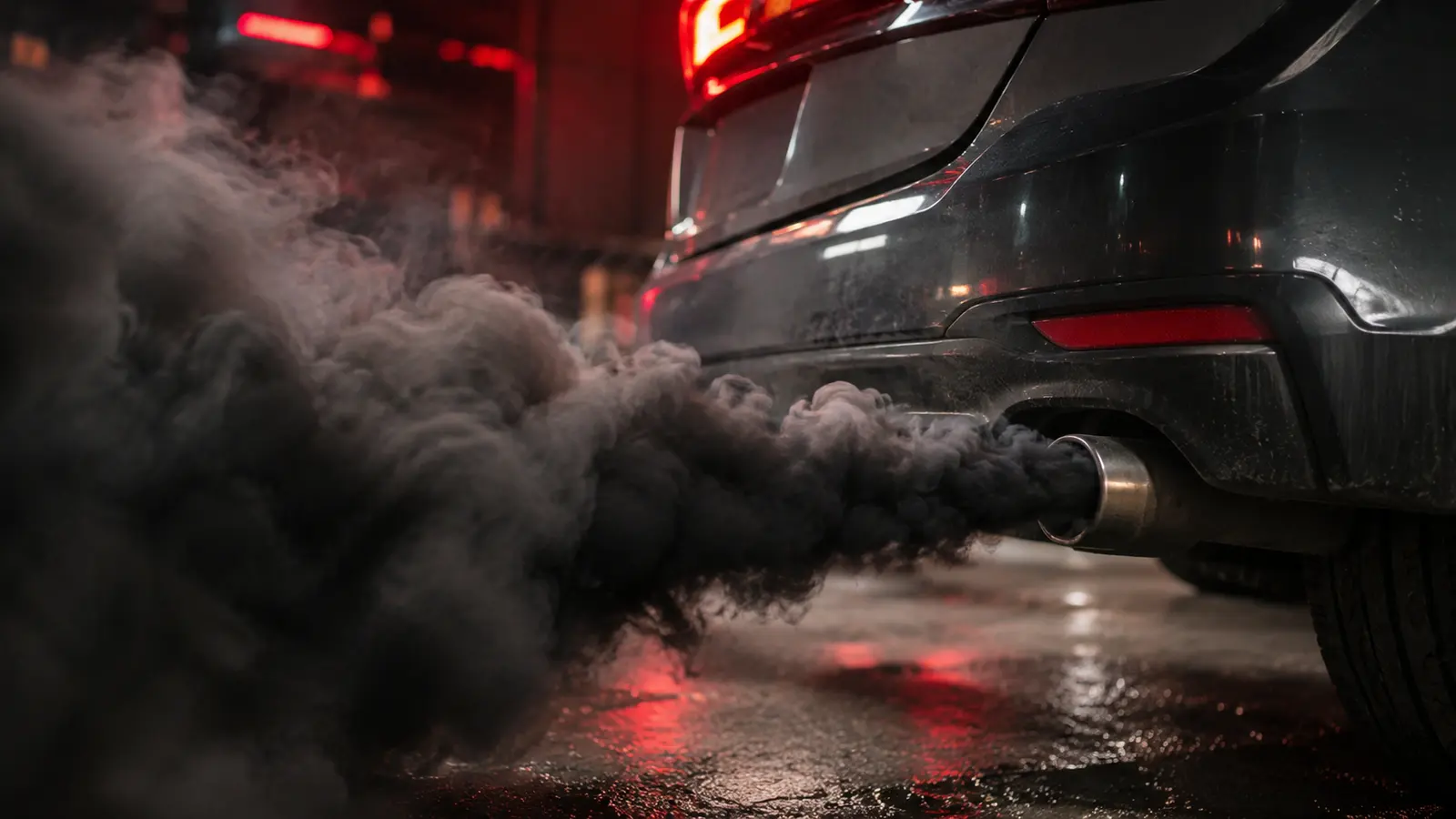
Black smoke means the engine is running rich, burning more fuel than air allows. A blocked air filter, leaking injectors, a faulty sensor or a turbo fault are common causes.
- Topic
- Engine Problems
- Sections
- 8
- Reading time
- 2 min
- Applies to
- All regions
Black smoke from the exhaust means the engine is running rich: burning more fuel than the available air can support. On petrol cars, common causes are a clogged air filter, leaking injectors, a faulty MAF or oxygen sensor or high fuel pressure. On diesels, add turbo problems, EGR faults and worn injectors.
Is it safe to drive?
Usually, for a short distance. Persistent black smoke wastes fuel and can damage the catalytic converter or DPF, so get it fixed soon. Stop if the check engine light flashes.
Causes at a glance
| Clue | Likely cause |
|---|---|
| Smoke plus sluggish acceleration | Clogged air filter or intake restriction |
| Fuel smell, poor economy, rich codes (P0172) | Leaking injector, fuel pressure regulator |
| Codes for MAF or O2 sensor | Sensor feeding wrong data |
| Diesel, smoke under load, little boost | Turbo or boost leak |
| Diesel, smoke and EGR codes | EGR valve stuck |
Check these in order
- Inspect the air filter.
- Scan for codes: rich codes like P0172, MAF (P0101) or O2 sensor codes.
- Check for intake leaks on turbo cars.
- Note fuel economy changes.
Causes explained
Air restriction
Less air with the same fuel means a rich mixture.
Injectors
A leaking or dribbling injector delivers extra fuel.
Sensors
A dirty MAF under-reads air, or a failed O2 sensor misleads fuel trims.
Diesel turbo and EGR
Low boost or a stuck-open EGR valve starves the engine of fresh air.
What a mechanic will do
They'll read fuel trims and sensor data, test fuel pressure, check injector balance, and test boost on turbo engines.
What affects the cost
Air filters are cheap. Sensors are moderate. Injectors and turbos cost more.
How to prevent it
- Replace the air filter on schedule.
- Use good-quality fuel.
Related problems
Frequently asked questions
Is black smoke from a diesel normal?
Older diesels can puff some black smoke under hard acceleration. Modern diesels with a DPF shouldn't smoke visibly.
Does black smoke waste fuel?
Yes. It's unburnt fuel, so economy drops and the catalytic converter or DPF can be damaged.
Can a bad oxygen sensor cause black smoke?
It can make the engine run rich on petrol cars, although it usually causes poor economy before visible smoke.
Tools that can help
How the parts involved work
Need a mechanic?
Find rated garages near you by city, ZIP code or postcode, with directions.
About this guide
Written by Editorial Team using manufacturer documentation, government road-safety guidance and motoring-organisation advice. It explains likely causes and safe checks. It is not a diagnosis. How we write and check guides.
More engine problems guides
Engine ProblemsCar Exhaust and Emissions: The Complete Guide to Catalytic Converters, Sensors and Smoke
The exhaust system carries burnt gases away, cleans them with a catalytic converter (and on diesels a DPF and SCR), and quietens the engine. This guide explains each part, what different smoke colours and noises mean, catalytic converter theft, and emissions tests.
Updated November 22, 2026Read Engine Problems
Engine Cooling System: The Complete Guide to Coolant, Overheating and Repairs
The cooling system carries heat away from the engine using coolant, a water pump, a thermostat, a radiator and fans, all under pressure so coolant can run above 100 °C. This guide explains each part, why engines overheat, how to spot leaks and how to check coolant safely.
Updated November 22, 2026Read Engine Problems
Diesel Engines: The Complete Guide to How They Work, DPF, AdBlue and Care
Diesel engines ignite fuel by compression rather than a spark. Modern diesels add glow plugs, a particulate filter, AdBlue and EGR to start reliably and cut emissions. This guide explains each system, the warning lights and how to keep a diesel healthy.
Updated November 22, 2026Read