
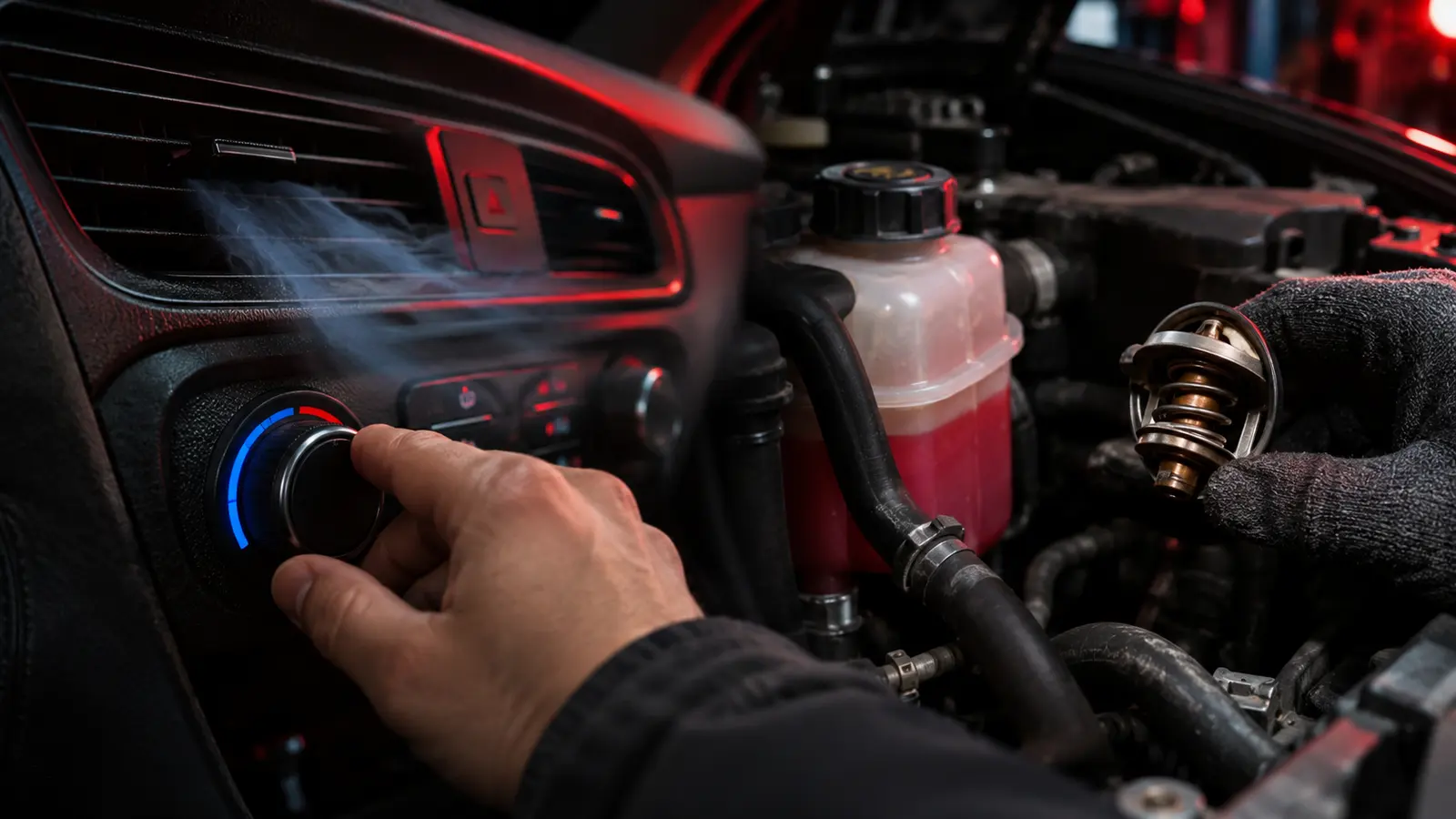
Car Heater Blowing Cold Air: 6 Causes and Fixes
Quick answer
Low coolant, a thermostat stuck open, a blocked heater core, an airlock or a faulty blend door are the usual reasons a car heater blows cold.
- Topic
- AC & Heating
- Sections
- 9
- Reading time
- 2 min
- Applies to
- All regions
If your car heater is blowing cold air, the usual causes are low coolant, a thermostat stuck open, a blocked heater core, an airlock after coolant work, or a faulty blend door. The temperature gauge is your best clue: if it reads low, suspect the thermostat. If it's normal, look at coolant flow and the heater controls.
Is it safe to drive?
Yes, if the temperature gauge stays normal and you can keep the windscreen clear. If the gauge rises high, or the windscreen fogs and won't clear, stop. Visibility matters as much as warmth.
Causes at a glance
| Clue | Likely cause |
|---|---|
| Temperature gauge stays low | Thermostat stuck open |
| Coolant level low | Leak; heater core runs dry first |
| Warm only at high revs | Low coolant, airlock, weak water pump |
| One side hot, other cold (dual zone) | Blend door actuator |
| Clicking behind the dashboard | Blend door actuator gear |
| Inlet hose hot, outlet cool | Blocked heater core |
Check these in order
- Engine cold: check the coolant level.
- Watch the temperature gauge after 10 minutes of driving.
- Feel the two heater hoses at the bulkhead once warm (carefully). Both should be hot.
- Listen for clicking when you change the temperature setting.
Causes explained
Low coolant
A leak lowers the level and the heater core loses flow first.
Thermostat stuck open
The engine never reaches normal temperature, which also hurts fuel economy and can set a code such as P0128.
Airlock
After coolant work, trapped air can block the heater core. Bleeding the system usually fixes it.
Blocked heater core
Old or mixed coolant can leave deposits that clog the core.
Blend door
A flap behind the dashboard mixes hot and cold air. If its motor or gear fails, you get cold air whatever you select.
What a mechanic will do
They'll pressure-test the cooling system, check the thermostat, bleed air, test hose temperatures and run heater control diagnostics.
What affects the cost
Topping up and bleeding is quick. Thermostats are moderate. Heater cores can take hours of labour.
How to prevent it
- Use the correct coolant and change it on schedule.
- Fix coolant leaks early.
Regional notes
This is a top winter search in Canada and the UK. In very cold regions, a car that barely warms up on short trips may also benefit from a block heater.
Related problems
Frequently asked questions
Can low coolant stop the heater working?
Yes. The heater core is often one of the highest points in the cooling system, so it's the first to run dry. Low coolant can also mean a leak.
Why is my heater only warm at high revs?
Low coolant or an airlock lets the heater core warm only when the water pump spins faster. A weak water pump can do the same.
Why is my temperature gauge low and the heater weak?
A thermostat stuck open lets the engine run too cold, so the heater never gets hot.
Tools that can help
How the parts involved work
Need a mechanic?
Find rated garages near you by city, ZIP code or postcode, with directions.
About this guide
Written by Editorial Team using manufacturer documentation, government road-safety guidance and motoring-organisation advice. It explains likely causes and safe checks. It is not a diagnosis. How we write and check guides.
More ac & heating guides
 AC & Heating
Car Air Conditioning and Heating: The Complete Guide
Car AC pumps refrigerant through a sealed loop to pull heat and moisture out of the cabin; the heater reuses engine heat through the heater core. This guide covers how both work, why they fail, how to demist fast, and how to keep them healthy.
Updated November 22, 2026ReadAC & HeatingCar AC Recharge: What It Is and When It's Needed
An AC recharge (regas) refills the refrigerant. Systems are sealed, so being low usually means a leak. A proper service recovers the old refrigerant, checks for leaks and refills the exact amount your car needs.
Updated November 22, 2026Read AC & Heating
Car Smells Musty or Mouldy After Rain: Why
A musty, mildew smell after rain means water is getting into the car and staying there: blocked scuttle or sunroof drains, a failed door seal, or a damp carpet and cabin filter. Find and fix the leak first, then dry everything.
Updated November 22, 2026Read