
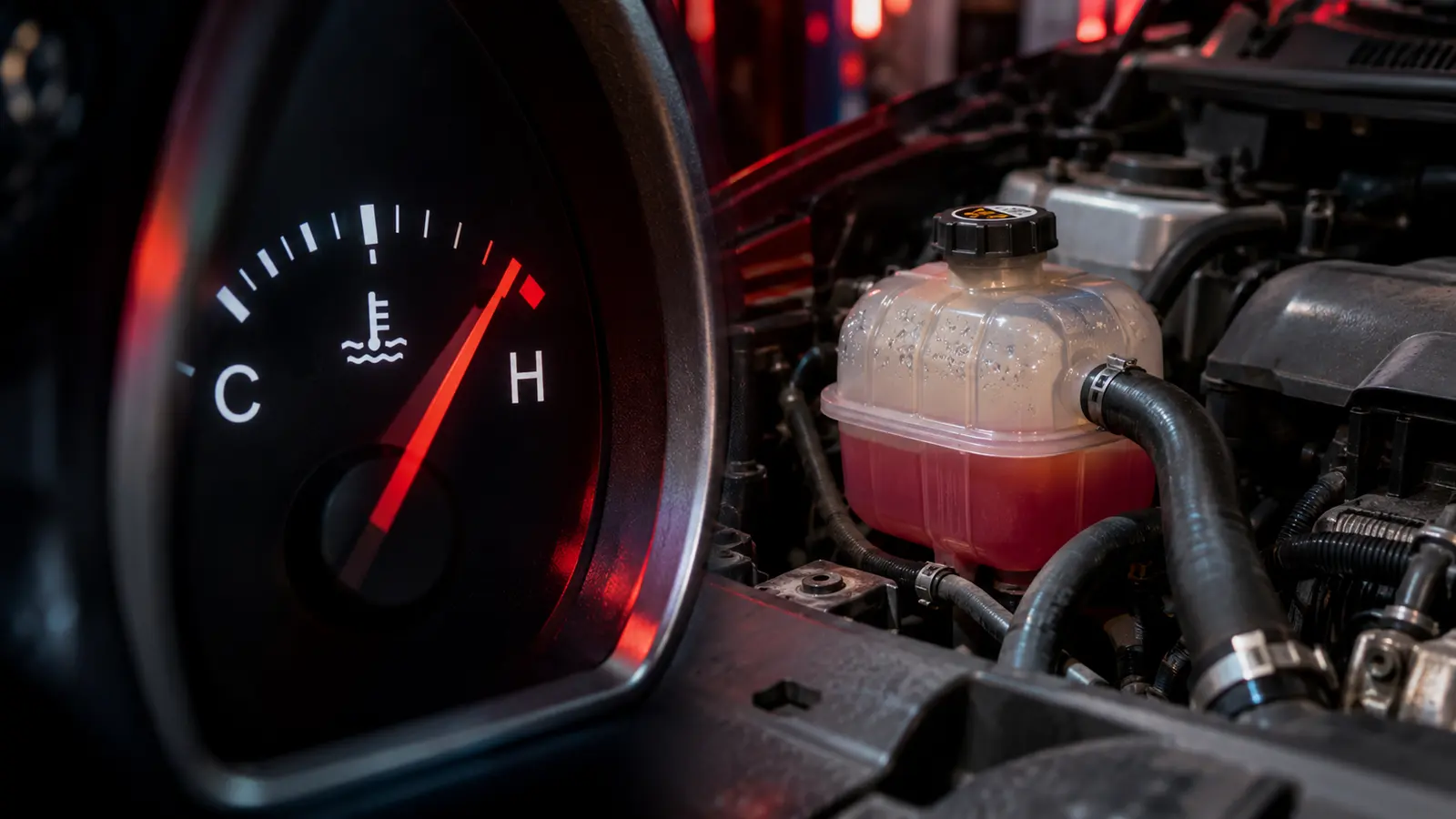
Temperature Gauge Going Up and Down: Causes
Quick answer
A gauge that swings up and down usually means a sticking thermostat, low coolant, trapped air in the system or a failing sensor. Treat rising temperatures seriously.
- Topic
- Engine Problems
- Sections
- 6
- Reading time
- 1 min
- Applies to
- All regions
When your temperature gauge goes up and down, the cooling system isn't regulating steadily. The usual causes are a sticking thermostat, low coolant, air trapped in the system, a failing radiator fan or a faulty temperature sensor.
Is it safe to drive?
If the gauge climbs towards hot, turn the heater to full, pull over safely and switch off. Don't keep driving an overheating engine.
Causes at a glance
| Pattern | Likely cause |
|---|---|
| Rises then suddenly drops | Thermostat sticking then opening |
| Rises in traffic, drops at speed | Cooling fan |
| Erratic after coolant work | Air lock |
| Low coolant, sweet smell | Leak |
| Gauge jumps instantly | Sensor or wiring |
Check these in order
- Coolant level when cold.
- Fan operation when hot or with AC on.
- Recent coolant work? Bleed the system.
- Read codes for temperature sensor faults.
What a mechanic will do
They'll pressure-test the cooling system, check the thermostat, bleed air and test the fans and sensor.
Prevention
- Keep coolant fresh and topped up.
- Bleed properly after any coolant work.
Related guides
Frequently asked questions
Can an air lock cause this?
Yes. Trapped air after coolant work causes erratic temperatures until the system is bled.
Is a faulty sensor possible?
Yes, but check coolant and the thermostat first because overheating is costly.
Tools that can help
Need a mechanic?
Find rated garages near you by city, ZIP code or postcode, with directions.
About this guide
Written by Editorial Team using manufacturer documentation, government road-safety guidance and motoring-organisation advice. It explains likely causes and safe checks. It is not a diagnosis. How we write and check guides.
More engine problems guides
 Engine Problems
Car Exhaust and Emissions: The Complete Guide to Catalytic Converters, Sensors and Smoke
The exhaust system carries burnt gases away, cleans them with a catalytic converter (and on diesels a DPF and SCR), and quietens the engine. This guide explains each part, what different smoke colours and noises mean, catalytic converter theft, and emissions tests.
Updated November 22, 2026Read Engine Problems
Engine Cooling System: The Complete Guide to Coolant, Overheating and Repairs
The cooling system carries heat away from the engine using coolant, a water pump, a thermostat, a radiator and fans, all under pressure so coolant can run above 100 °C. This guide explains each part, why engines overheat, how to spot leaks and how to check coolant safely.
Updated November 22, 2026Read Engine Problems
Diesel Engines: The Complete Guide to How They Work, DPF, AdBlue and Care
Diesel engines ignite fuel by compression rather than a spark. Modern diesels add glow plugs, a particulate filter, AdBlue and EGR to start reliably and cut emissions. This guide explains each system, the warning lights and how to keep a diesel healthy.
Updated November 22, 2026Read