
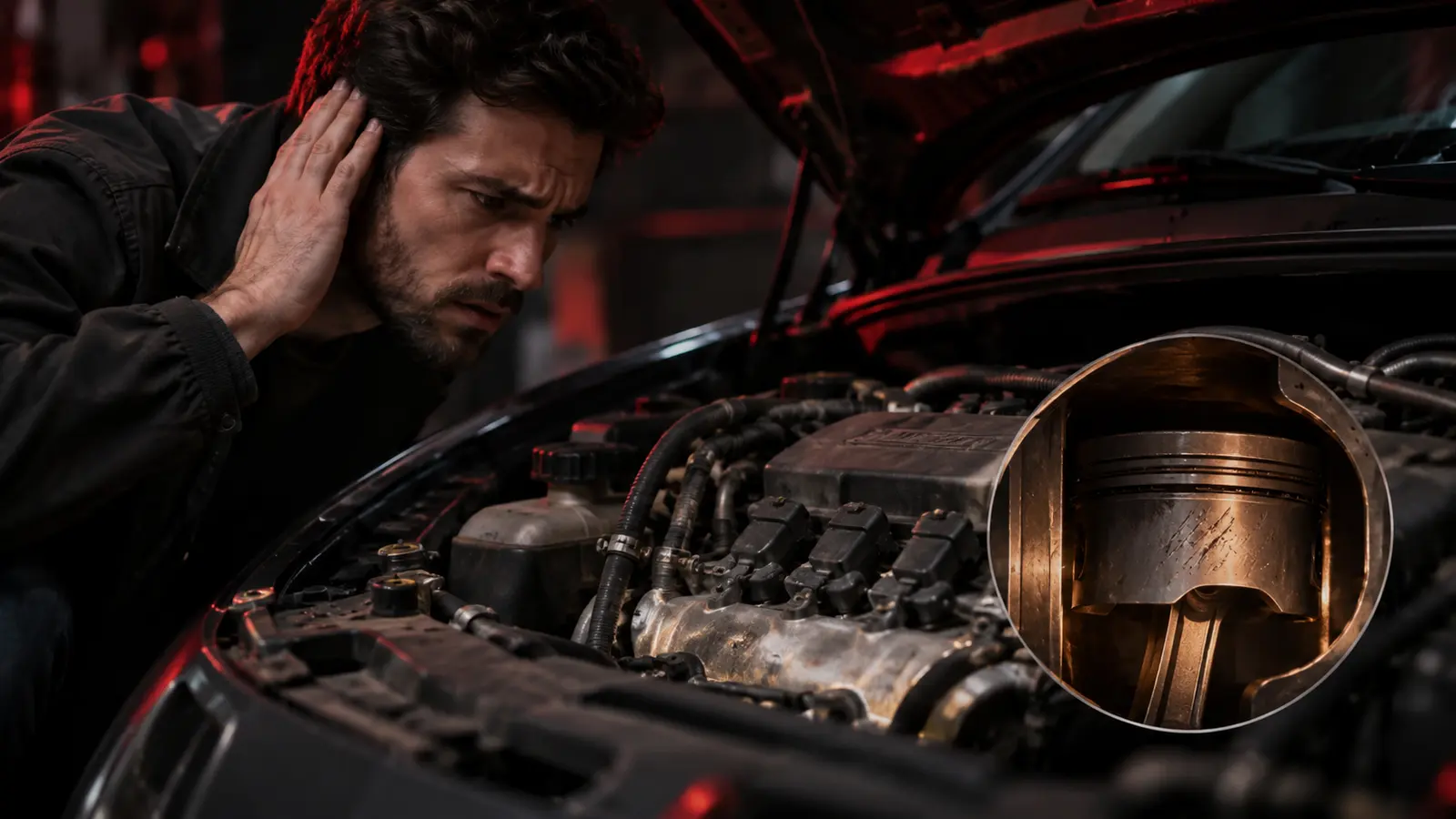
Engine Knocking Noise: Causes and How Serious It Is
Part of: Car Noises: What That Sound Means
Quick answer
A light pinging or rattling under load is usually detonation (pre-ignition). A deep, rhythmic knock that rises with engine speed can be a worn bearing, which is serious.
- Topic
- Engine Problems
- Sections
- 8
- Reading time
- 2 min
- Applies to
- All regions
Engine knocking comes in two very different forms. A light pinging or rattle under acceleration is usually detonation, where fuel ignites too early. It's often caused by lower-octane fuel than required, carbon build-up or a lean mixture. A deep, heavy knock from low in the engine that rises with revs can be rod knock from a worn bearing, which is serious.
Is it safe to drive?
Pinging: drive gently and try the correct fuel. Deep knocking: stop driving and get it inspected. Continuing can destroy the engine. Stop immediately if the oil pressure light comes on.
Knocks at a glance
| Sound | Likely cause | Urgency |
|---|---|---|
| Light pinging uphill or accelerating | Detonation (fuel, carbon, lean) | Fix soon |
| Deep knock rising with revs | Rod or main bearing wear | Stop now |
| Knock when cold, quieter warm | Piston slap | Monitor |
| Knock with oil light | Oil starvation | Stop now |
| Clunk over bumps | Not engine: suspension | Check soon |
Check these in order
- Check oil level and pressure light.
- Use the fuel grade in your handbook.
- Scan for codes like knock sensor P0325 or lean codes.
- Note when it happens: under load, at idle, cold, warm.
Causes explained
Detonation
Unburnt mixture ignites spontaneously, causing a pressure spike. Wrong octane, excess heat and carbon raise the risk.
Rod and main bearings
Oil starvation and wear leave clearance. The crankshaft hammers the bearing, causing a deep knock.
Piston slap
Pistons rock in worn bores when cold. Often noisy but not immediately dangerous.
What a mechanic will do
They'll check oil pressure with a gauge, listen with a stethoscope, read knock sensor data, and check for carbon build-up.
What affects the cost
Fuel and carbon cleaning are cheaper. Bearing failure usually means engine rebuild or replacement.
How to prevent it
- Use the specified fuel grade and oil.
- Keep oil changes on time.
Related problems
Frequently asked questions
Can the wrong fuel cause knocking?
Yes. Using lower-octane fuel than the maker requires can cause detonation, heard as pinging under load.
What does rod knock sound like?
A deep, heavy knock from low in the engine that gets faster with revs and often louder under load. Stop driving and get it inspected.
What does a knock sensor do?
It listens for detonation and retards ignition timing to protect the engine. A failed sensor can set a code such as P0325.
Tools that can help
How the parts involved work
Need a mechanic?
Find rated garages near you by city, ZIP code or postcode, with directions.
About this guide
Written by Editorial Team using manufacturer documentation, government road-safety guidance and motoring-organisation advice. It explains likely causes and safe checks. It is not a diagnosis. How we write and check guides.
More engine problems guides
 Engine Problems
Car Exhaust and Emissions: The Complete Guide to Catalytic Converters, Sensors and Smoke
The exhaust system carries burnt gases away, cleans them with a catalytic converter (and on diesels a DPF and SCR), and quietens the engine. This guide explains each part, what different smoke colours and noises mean, catalytic converter theft, and emissions tests.
Updated November 22, 2026Read Engine Problems
Engine Cooling System: The Complete Guide to Coolant, Overheating and Repairs
The cooling system carries heat away from the engine using coolant, a water pump, a thermostat, a radiator and fans, all under pressure so coolant can run above 100 °C. This guide explains each part, why engines overheat, how to spot leaks and how to check coolant safely.
Updated November 22, 2026Read Engine Problems
Diesel Engines: The Complete Guide to How They Work, DPF, AdBlue and Care
Diesel engines ignite fuel by compression rather than a spark. Modern diesels add glow plugs, a particulate filter, AdBlue and EGR to start reliably and cut emissions. This guide explains each system, the warning lights and how to keep a diesel healthy.
Updated November 22, 2026Read