
Quick answer
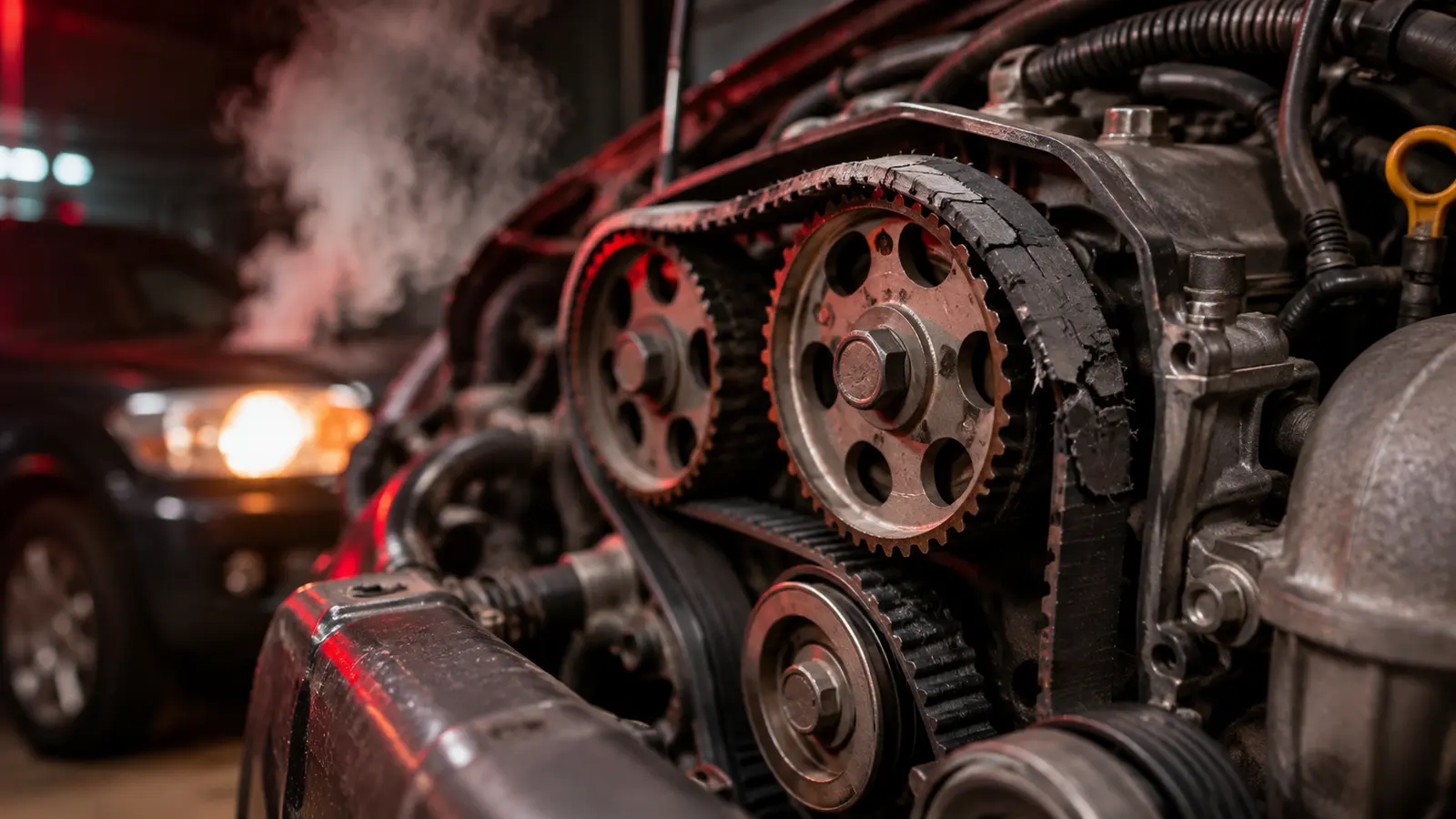
A worn timing belt often gives little warning. Ticking from the timing cover, misfires, oil leaks at the front of the engine, or a sudden no-start can all point to it. Replace it on schedule.
- Topic
- Engine Problems
- Sections
- 8
- Reading time
- 1 min
- Applies to
- All regions
The timing belt keeps the crankshaft and camshafts in sync. Timing belt failure often gives little warning, so replacing it at the maker's interval is the real protection. Warning signs, when you get them, include ticking from the timing cover, misfires from a belt that's jumped a tooth, an oil leak at the front of the engine soaking the belt, and a sudden no-start.
Is it safe to drive?
If you suspect the belt, or it's overdue, avoid driving until it's checked. A snapped belt stops the engine instantly and can cause serious damage.
Signs at a glance
| Sign | What it means |
|---|---|
| Overdue on the service schedule | Highest risk: book replacement |
| Ticking or slapping from timing cover | Worn belt or tensioner |
| Misfires, rough running, timing codes | Belt jumped a tooth |
| Oil leak at front of engine | Oil degrading the belt |
| Engine cranks fast but won't start | Belt may have snapped |
Belt or chain?
Many modern engines use a chain, which usually isn't scheduled for replacement but can stretch and rattle on start-up. Belts have a fixed interval in miles and years.
Interference engines
On interference engines, valves and pistons share space at different times. If the belt breaks, they collide. That's why the interval matters.
What a mechanic will do
They'll replace the belt, tensioner and idlers as a kit, and often the water pump if it's belt-driven.
What affects the cost
Labour time to reach the belt. Doing the water pump at the same time avoids paying for the labour twice.
How to prevent it
- Follow the interval by miles and years.
- Fix front-of-engine oil leaks.
Related problems
Frequently asked questions
What happens if a timing belt breaks?
The engine stops immediately. On an interference engine, pistons can hit valves, causing major damage.
Does my car have a belt or a chain?
Check the handbook or service schedule. Chains usually aren't scheduled for replacement; belts are.
When should a timing belt be replaced?
At the maker's interval, often given in both miles and years. Many fall somewhere around 60,000–100,000 miles, but some are shorter. The age limit matters too.
Tools that can help
How the parts involved work
Need a mechanic?
Find rated garages near you by city, ZIP code or postcode, with directions.
About this guide
Written by Editorial Team using manufacturer documentation, government road-safety guidance and motoring-organisation advice. It explains likely causes and safe checks. It is not a diagnosis. How we write and check guides.
More engine problems guides
 Engine Problems
Car Exhaust and Emissions: The Complete Guide to Catalytic Converters, Sensors and Smoke
The exhaust system carries burnt gases away, cleans them with a catalytic converter (and on diesels a DPF and SCR), and quietens the engine. This guide explains each part, what different smoke colours and noises mean, catalytic converter theft, and emissions tests.
Updated November 22, 2026Read Engine Problems
Engine Cooling System: The Complete Guide to Coolant, Overheating and Repairs
The cooling system carries heat away from the engine using coolant, a water pump, a thermostat, a radiator and fans, all under pressure so coolant can run above 100 °C. This guide explains each part, why engines overheat, how to spot leaks and how to check coolant safely.
Updated November 22, 2026Read Engine Problems
Diesel Engines: The Complete Guide to How They Work, DPF, AdBlue and Care
Diesel engines ignite fuel by compression rather than a spark. Modern diesels add glow plugs, a particulate filter, AdBlue and EGR to start reliably and cut emissions. This guide explains each system, the warning lights and how to keep a diesel healthy.
Updated November 22, 2026Read