
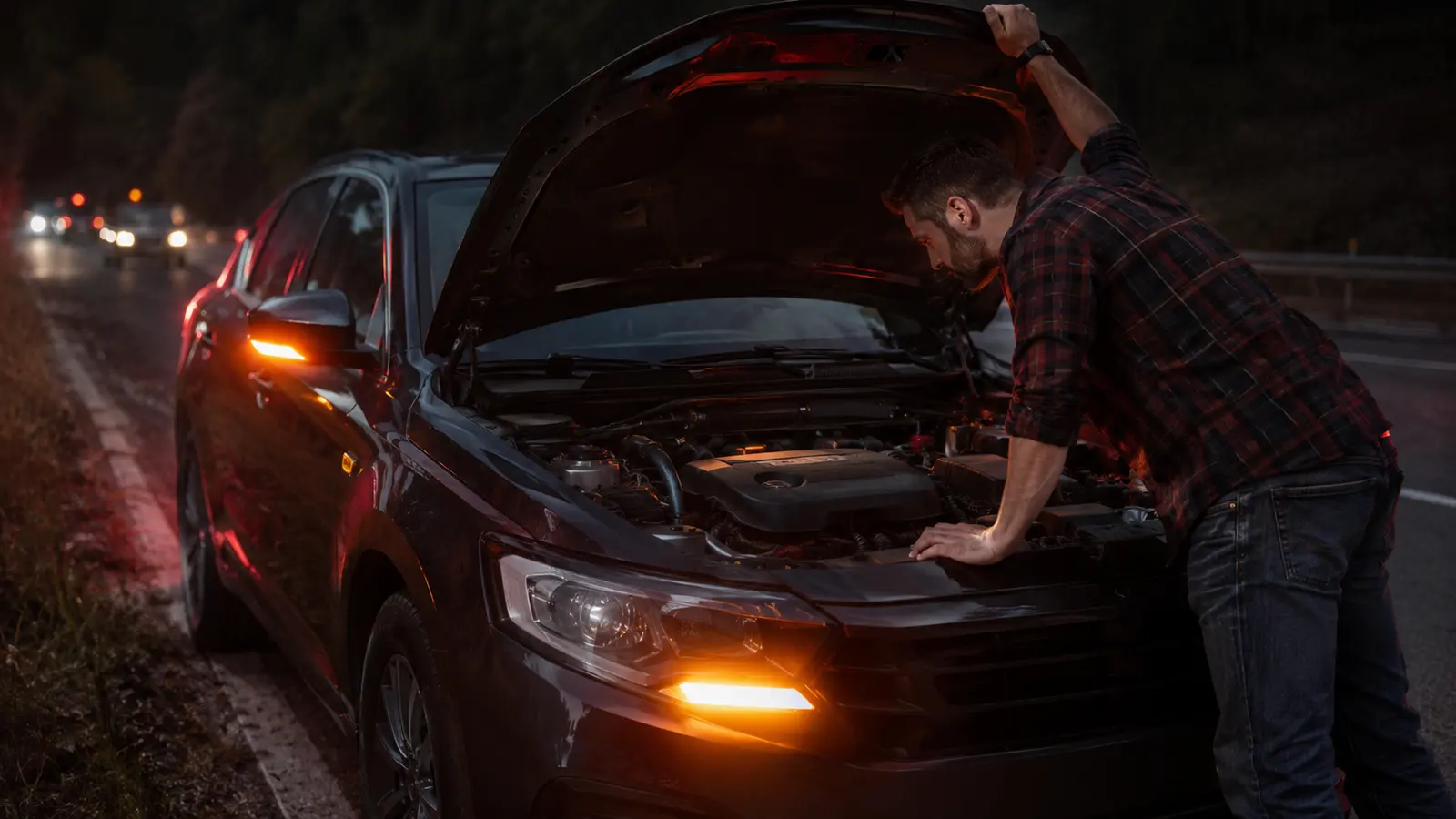
Car Died While Driving and Won't Restart? What to Do Next
Quick answer
If your car cuts out while driving and won't restart, get safe first, then use what happened just before it died to narrow the cause: charging system, fuel delivery, ignition or a serious engine fault.
- Topic
- Starting & Battery
- Sections
- 10
- Reading time
- 4 min
- Applies to
- All regions
A car that dies while you're driving and then won't restart is frightening, but the order you handle it in matters. First get yourself safe. Then use what happened in the seconds before it stopped, because that is the best clue to the cause. The usual culprits are a failed charging system, a fuel delivery problem, an ignition or sensor fault, or occasionally a serious mechanical failure such as a snapped timing belt.
This question is rising fast in Google searches right now. Here's the calm, practical version from the AllInformations Automotive team.
First: get safe
Losing the engine also means losing power assistance. The steering and brakes still work, but they need much more effort.
- Hazard lights on straight away.
- Steer firmly to the shoulder, verge or a side road while you still have momentum.
- Brake with a firm, steady push. The servo may have one or two assisted presses left.
- Once stopped, set the parking brake and, if it's safe, get everyone out and away from traffic.
- On a motorway or highway, stand behind the barrier and call for help rather than working on the car.
If the car stalls in snow, NHTSA advises staying with the vehicle, keeping it visible, and clearing snow from the exhaust before running the engine to keep warm, to avoid carbon monoxide build-up.
What happened just before it died?
This is the most useful thing you can tell a mechanic, so note it down while it's fresh.
| What you noticed | Most likely area |
|---|---|
| Battery light on, dim lights, radio cut out first | Charging system (alternator or belt) |
| Spluttering, jerking or loss of power uphill | Fuel delivery (pump, filter, pressure) |
| Sudden cut-out, as if the key was turned off | Ignition, crank sensor or a relay |
| Loud bang or rattle, then silence | Mechanical (timing belt or chain) |
| Temperature gauge high, steam | Overheating |
| Fuel gauge low or unreliable | Simply out of fuel |
Cause 1: the alternator stopped charging
When the alternator or its drive belt fails, the car runs on battery power alone. Electrics fade one by one until there isn't enough voltage for the ignition and injectors, and the engine stops. It then won't restart because the battery is flat.
Clues: battery warning light, flickering or dimming dashboard lights, electric windows slowing down. See symptoms of a bad alternator and dashboard lights flickering.
What helps: a jump start may get you a short distance, but the car will die again. It needs the charging system fixed.
Cause 2: fuel isn't getting through
A weak fuel pump, a blocked filter or a failed pump relay starves the engine. It often stutters or loses power first, especially under load.
Clues: surging or hesitation before it stopped. At key-on you may no longer hear the short hum of the pump priming. Read symptoms of a bad fuel pump.
Don't rule out the obvious. A fuel gauge that reads wrong can leave you stranded with an empty tank. See fuel gauge not working.
Cause 3: ignition or sensor failure
A failed crankshaft position sensor is a classic cause of a sudden cut-out with no warning. The engine computer loses the signal it needs to time sparks and injection, so it stops everything. These sensors often fail when hot and may work again once cooled. The crankshaft position sensor explainer covers how it works.
Clues: the engine cranks normally but won't fire, and the check engine light may store a code.
Cause 4: a mechanical failure
If you heard a bang, clatter or sudden rattle before it died, don't keep cranking. A broken timing belt on some engines lets pistons hit valves, and cranking can add damage. If the engine cranks unusually fast and easily, that's another hint. Have the car recovered rather than driven.
Cause 5: overheating
Some engines shut down or go into a protection mode when they overheat. If the temperature gauge was high or you saw steam, let it cool fully before opening anything. Follow our smoke from under the bonnet steps.
What to try at the roadside
Only do this if you're somewhere safe:
- Check the fuel gauge and how far you've driven since filling up.
- Turn the key to on (without cranking) and listen for the fuel pump's two-second hum.
- Watch the dashboard. Are the warning lights bright or dim? Dim points to a flat battery.
- Try a restart two or three times. Don't crank for long.
- Look for obvious problems: a thrown drive belt, a disconnected battery terminal, a puddle of fuel.
If the lights come on but nothing happens when you turn the key, our guide to car won't start but lights come on walks through the next checks.
When to call for recovery
Call breakdown assistance or a tow if you smell fuel, heard a mechanical bang, saw steam, or the car won't restart after a few tries. A technician can read fault codes, test fuel pressure and check the charging system at the roadside or in the workshop.
The bottom line
A car that dies on the move is telling you something, and the clue is usually in the last 30 seconds before it stopped. Get safe, note what you saw and heard, try a couple of restarts, and let a professional take it from there. Regular checks of the battery and charging system before winter are the best way to avoid it. Our winter car maintenance checklist covers what to check.
Frequently asked questions
Can a bad battery make a car die while driving?
Rarely on its own. Once the engine is running, the alternator powers the car. A car that dies while driving is more often a charging fault that has slowly drained the battery.
Should I keep trying to start it?
Try two or three times, a few seconds each. Long cranking can overheat the starter and, if fuel is getting through but not burning, can damage the catalytic converter.
Is it safe to drive once it restarts?
Only as far as a safe place or a garage. Whatever made it stop is still there, and it may cut out again somewhere less safe.
Tools that can help
Need a mechanic?
Find rated garages near you by city, ZIP code or postcode, with directions.
About this guide
Written by Editorial Team using manufacturer documentation, government road-safety guidance and motoring-organisation advice. It explains likely causes and safe checks. It is not a diagnosis. How we write and check guides.
More from the blog
 Seasonal Driving
Winter Car Emergency Kit: What to Keep in Your Car
A winter car kit should keep you able to see, get moving, call for help and stay warm while you wait. Both NHTSA and the UK Highway Code publish lists: scraper and de-icer, shovel, traction aid, jump leads, torch, first aid kit, blankets, water and food.
Updated November 22, 2026Read Seasonal Driving
Should You Warm Up Your Car in Winter? What the Evidence Says
For most modern cars the answer is no: FuelEconomy.gov says most manufacturers recommend driving off gently after about 30 seconds, because the engine warms faster while driving. Clear all the glass first, though.
Updated November 22, 2026ReadSeasonal DrivingHow to Drive on Black Ice (and How to Spot It)
Black ice is a thin, clear glaze you can barely see. Slow down early, leave far more space (the Highway Code says stopping distances can be ten times longer on ice), and make every input gentle. If you skid, look and steer where you want to go.
Updated November 22, 2026Read