
Free Check Engine Light Scans: What You Get and What You Don't
Quick answer
A free code read tells you which fault the engine computer has stored. It doesn't tell you which part has failed. Use it as a starting point, and never buy parts on a code alone.
- Topic
- Warning Lights
- Sections
- 8
- Reading time
- 3 min
- Applies to
- All regions
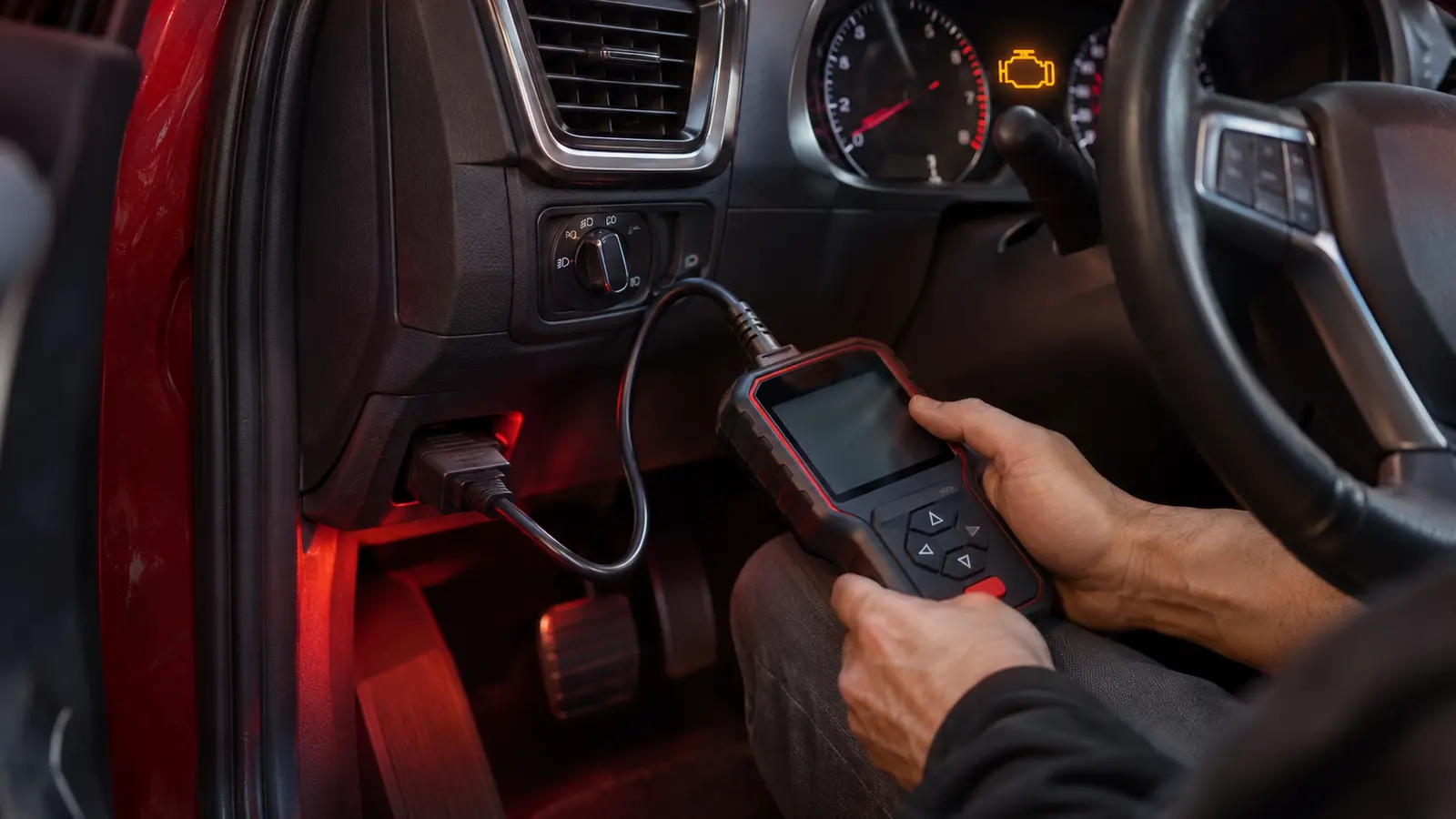
With winter on the way, more drivers are searching for free check engine light scans, and in particular whether parts stores do them for free. Many US auto parts chains do offer free code reading in store. O'Reilly, for example, describes its free "VeriScan" check engine light testing on its website. Here's what that scan actually gives you, its limits, and how to use the result sensibly.
What the check engine light is
The check engine light (also called the malfunction indicator lamp) is part of your car's on-board diagnostics (OBD-II) system, standard on US cars since the 1996 model year. When the engine computer sees a sensor reading outside its expected range, especially one that could raise emissions, it stores a diagnostic trouble code and turns on the light.
For a refresher on the light itself, see the check engine light explainer.
What a free scan gives you
A store employee plugs a scanner into the OBD-II port under your dashboard and reads:
- The stored code or codes, such as P0420 or P0301.
- A short description, such as "catalyst efficiency below threshold" or "cylinder 1 misfire".
- Sometimes freeze-frame data, a snapshot of conditions when the fault was logged.
- Often a printout suggesting common causes, and the parts they sell for it.
It takes a few minutes and costs nothing, which makes it a great first step.
What a free scan doesn't tell you
A code says what the computer noticed, not what broke. For example:
- P0171 (system too lean) can be a vacuum leak, a dirty MAF sensor, a weak fuel pump or a leaking injector.
- P0420 (catalyst efficiency) can be the catalytic converter, but also an oxygen sensor or an exhaust leak.
- A misfire code can be a spark plug, an ignition coil, an injector or low compression.
That's why the honest advice is to never buy parts on a code alone. A proper diagnosis tests the suspects before replacing anything.
Solid or flashing? This changes everything
| Light | What it means | What to do |
|---|---|---|
| Solid | A fault is logged | Get the code read soon |
| Flashing | Active, severe misfire | Reduce speed, avoid hard acceleration, get it checked promptly |
| Comes and goes | Intermittent fault | Get the code read; it's still stored |
A flashing light can mean unburned fuel is reaching the catalytic converter, which can overheat and damage it. See check engine light flashing.
Before you go for a scan
- Check the fuel cap. A loose cap can trigger an evaporative-system code. Tighten it and see whether the light clears after a few drives.
- Note the symptoms, such as rough running, poor economy or smells. Codes plus symptoms are far more useful than codes alone.
- Write the code down (or photograph the printout) so you can look it up later and share it with a mechanic.
After the scan: your next steps
- Look up the code in our OBD2 code lookup to understand the common causes.
- Check the simple things that match the code, such as the fuel cap, obvious vacuum hoses or recently disturbed connectors.
- Book a diagnosis if it isn't obvious. A good technician will test before replacing.
- Don't clear the code until the repair is done. Clearing it doesn't fix anything, and an emissions test will fail until the system's readiness monitors have completed again.
Should you buy your own scanner?
If you like to keep an eye on your car, an inexpensive OBD-II reader pays for itself quickly. It lets you see codes the moment the light comes on, check whether a repair worked, and confirm readiness before an inspection. Our guide on how to use an OBD2 scanner covers the basics, and how to reset a car ECU explains when clearing codes makes sense.
The bottom line
A free check engine light scan is worth having. It turns a vague warning into a specific clue. Just remember it's the start of a diagnosis, not the end of one. If the light keeps coming back, our guide on why the check engine light comes on and off explains intermittent faults.
Frequently asked questions
Is a free code read the same as a diagnosis?
No. A code read retrieves the stored fault code. A diagnosis involves testing to find which part or wiring fault caused it.
Should I clear the code after the scan?
Not until the cause is fixed. Clearing it erases useful information, and the light will return if the fault is still there.
Can I read the codes myself?
Yes. Cars sold in the US since 1996 use OBD-II, and an inexpensive scanner plugs into the port under the dashboard.
Tools that can help
Need a mechanic?
Find rated garages near you by city, ZIP code or postcode, with directions.
About this guide
Written by Editorial Team using manufacturer documentation, government road-safety guidance and motoring-organisation advice. It explains likely causes and safe checks. It is not a diagnosis. How we write and check guides.
More from the blog
 Seasonal Driving
Winter Car Emergency Kit: What to Keep in Your Car
A winter car kit should keep you able to see, get moving, call for help and stay warm while you wait. Both NHTSA and the UK Highway Code publish lists: scraper and de-icer, shovel, traction aid, jump leads, torch, first aid kit, blankets, water and food.
Updated November 22, 2026Read Seasonal Driving
Should You Warm Up Your Car in Winter? What the Evidence Says
For most modern cars the answer is no: FuelEconomy.gov says most manufacturers recommend driving off gently after about 30 seconds, because the engine warms faster while driving. Clear all the glass first, though.
Updated November 22, 2026ReadSeasonal DrivingHow to Drive on Black Ice (and How to Spot It)
Black ice is a thin, clear glaze you can barely see. Slow down early, leave far more space (the Highway Code says stopping distances can be ten times longer on ice), and make every input gentle. If you skid, look and steer where you want to go.
Updated November 22, 2026Read