
Quick answer
Most car batteries last around three to five years. Hot climates, lots of short trips, deep discharges and stop-start use all shorten that.
- Topic
- Starting & Battery
- Sections
- 6
- Reading time
- 1 min
- Applies to
- All regions
Most car batteries last around three to five years. Life is shorter in hot climates, with lots of short trips, after deep discharges (such as leaving lights on), and in cars with heavy electrical loads or start-stop systems.
Signs your battery is ageing
- Slower cranking, especially on cold mornings
- Dim lights at start-up
- Start-stop system that rarely activates
- Needing jump starts
- Battery more than four years old
What affects battery life
| Factor | Effect |
|---|---|
| High heat | Speeds up internal corrosion |
| Short trips | Battery never fully recharges |
| Deep discharge | Permanent capacity loss |
| Vibration and loose mounting | Internal damage |
| Wrong battery type | Early failure in start-stop cars |
How to test it
A voltage reading shows charge, and a load or conductance test shows health. Many garages and parts stores test batteries quickly. See how to test a car battery with a multimeter.
How to make a battery last longer
- Take a longer drive weekly or use a smart maintainer.
- Keep terminals clean and the battery securely clamped.
- Fit the correct type (AGM or EFB for start-stop).
- Avoid running electrics with the engine off.
Regional notes
In hot regions of Australia and the southern US, expect shorter battery life. In Canada and the northern US, test the battery every autumn.
Related guides
Frequently asked questions
Do batteries last longer in cold climates?
Heat tends to age batteries faster, but cold reveals weak batteries because cranking demand rises.
Do AGM batteries last longer?
In demanding stop-start use they often do, but they still wear out.
Tools that can help
Need a mechanic?
Find rated garages near you by city, ZIP code or postcode, with directions.
About this guide
Written by Editorial Team using manufacturer documentation, government road-safety guidance and motoring-organisation advice. It explains likely causes and safe checks. It is not a diagnosis. How we write and check guides.
More starting & battery guides
 Starting & Battery
Car Batteries: The Complete Guide to Types, Testing, Care and Replacement
A 12-volt car battery starts the engine and steadies the electrics; the alternator then keeps it charged. This guide covers how batteries work, the main types, what the ratings mean, how to test and charge one, why they fail and how to replace one safely.
Updated November 22, 2026Read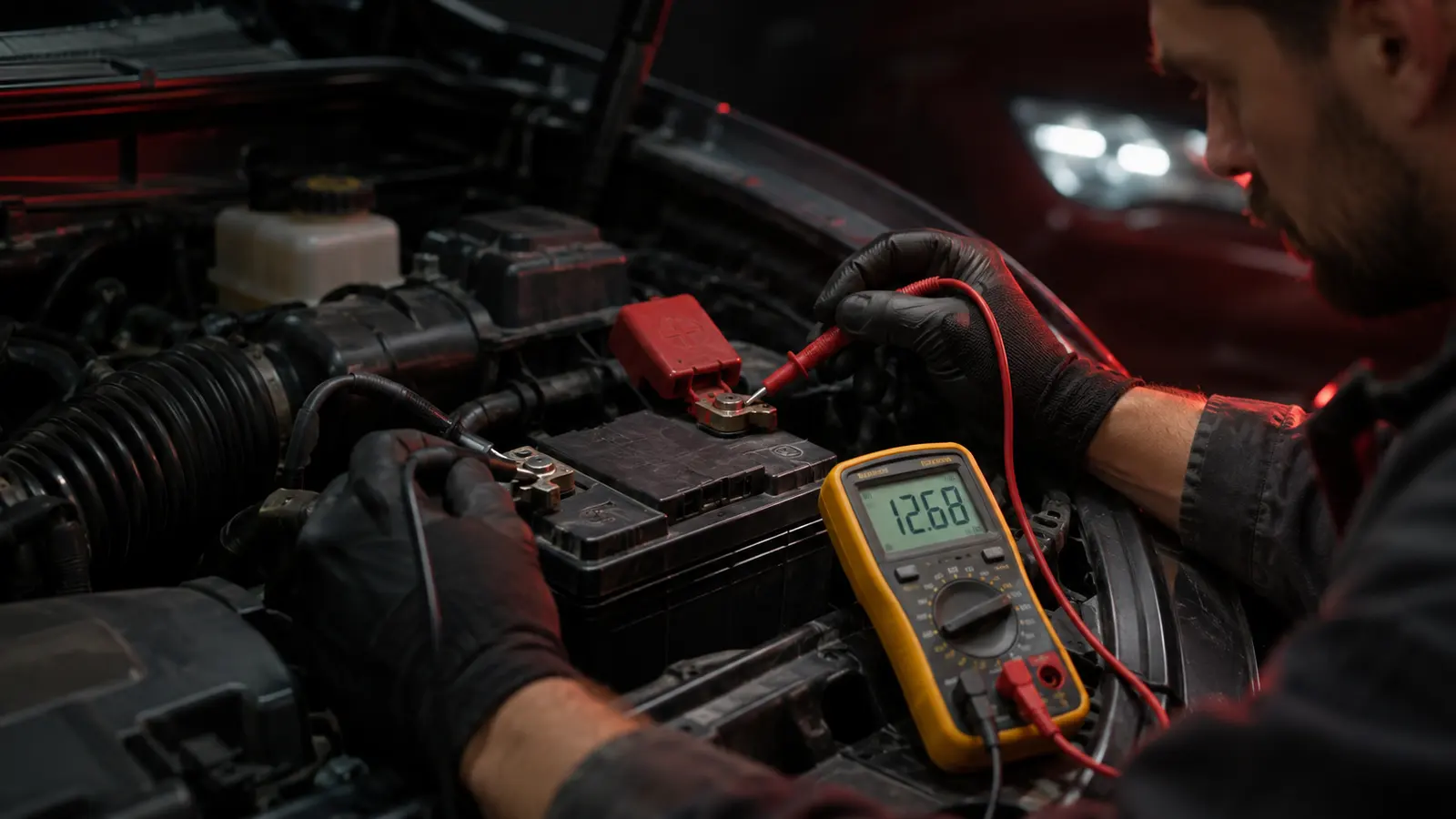 Starting & Battery
Car Battery Voltage Chart: What Your Reading Means
A fully charged 12-volt car battery rests at about 12.6 volts. With the engine running, the alternator should hold the system between about 13.5 and 14.5 volts. Readings well below those point to a flat battery or a charging fault.
Updated November 22, 2026Read Starting & Battery
Car Won't Start but the Lights Come On: What It Means
Working lights mean the battery has some charge — not that it can crank the engine. The sound the car makes points to the cause.
Updated November 22, 2026Read